

Friday, DECEMBER 19, 2025 |
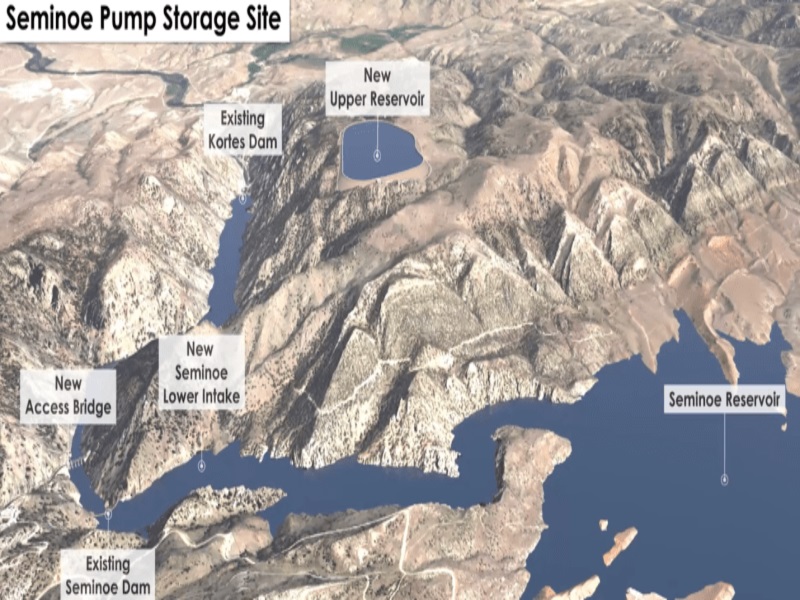
Photo – Seminoe Pumped Storage Facility image – Courtesy rPlus Hydro
The developers of the proposed Seminoe Pumped Storage Facility respond to questions and criticisms about the project.
As reported by Bigfoot99, Utah‑based rPlus Hydro is pursuing a large‑scale infrastructure project at Seminoe Reservoir. The energy company has proposed building a 13,000-acre-foot man‑made lake on top of nearby Bennett Mountain, connected to the existing reservoir by a 1,000‑foot underground tunnel. During periods of high energy production, water would be pumped from Seminoe Reservoir into the upper lake. When demand outpaces production, the water would flow back downhill through an underground turbine, generating electricity.
Speaking at the November 4th Board of Carbon County Commissioners meeting, rPlus Hydro Managing Director of Hydro Strategy Matthew Shapiro reported that filling the man-made upper lake would draw 14,000 acre-feet from Seminoe Reservoir, with an additional 400 acre-feet per year to offset evaporation losses.
Speaking to Bigfoot99, Shapiro explained the numbers he presented to the Commissioners were drastically overstated. Instead of losing 400 acre‑feet of water a year to evaporation, the upper lake would lose 272 acre‑feet, a 32 percent reduction. Additionally, Shapiro said filling the upper lake will lower the water level of Seminoe Reservoir, further reducing overall evaporative loss.
Shapiro said as part of its agreement with the Bureau of Reclamation and Casper Alcova Irrigation District, rPlus Hydro is paying for the water lost by normal evaporation as well as any additional loss from the project itself.
The Seminoe Pumped Storage Project is slated to occupy nearly 1,026 acres of Bureau of Land Management land, 77 acres under the Bureau of Reclamation, and 830 acres of private property. Much of that land is home to the Ferris-Seminoe Bighorn Sheep Herd Unit. In the most recent Federal Energy Regulatory Commission environmental impact statement, the Wyoming Game and Fish Department noted that construction noise, vibrations, and lighting could disturb the herd and recommended limiting work to a four‑month window, from May through August.
Hydro Strategy Managing Director Shapiro said that following Game and Fish recommendations would drive up project costs and lengthen the construction schedule, ultimately causing greater disturbance to the bighorn sheep.
To reduce the impact of construction on the Ferris‑Seminoe Bighorn Sheep Herd Unit, Shapiro said rPlus Hydro is considering relocating the project’s spoil piles and concrete plant. Instead of the originally proposed site in the Red Hills area 3.7 miles away, the company has identified a location roughly half that distance on Bureau of Reclamation land.
Shapiro said rPlus has filed new documents with FERC outlining plans for stricter traffic controls, noise reduction, and speed limits to minimize the impact on bighorn sheep in the area. rPlus has also agreed to move the intake structure’s build site farther away from the nearby state park.
Because of those newly proposed mitigation efforts, Shapiro said the energy company is asking the Bureau of Land Management to permit year-round construction.
Despite moving the spoilage and concrete plant off BLM land and onto Bureau of Reclamation property, Shapiro said enough of the project remains on BLM land to still require those seasonal‑restriction waivers. The hydro strategy managing director added that the environmental impacts will stop once construction is complete.
rPlus Hydro must also secure a visual resource management waiver from the Bureau of Land Management. Shapiro explained that the proposed upper‑reservoir site is designated as a Class II visual resource management area, meaning BLM’s objective is to keep the landscape’s character largely intact. A class reduction will likely be required for the project to continue.
Opponents say the Seminoe Pumped Storage Project could harm the Miracle Mile. Shapiro said state and federal agencies will not allow the project to negatively affect the world‑class blue ribbon trout fishery. rPlus Hydro commissioned a water‑temperature study of the North Platte River, specifically below Kortes Dam, which Shapiro said showed no measurable effect, or at most a slight benefit to the area.
To ensure the models reflect real‑world conditions, Shapiro said rPlus will continuously monitor water temperatures in both the Seminoe Reservoir and Miracle Mile throughout the life of the project. If the facility is ever shown to raise water temperatures, operations will be scaled back until levels return to normal.
Shapiro said project opponents claim the facility will draw tens of thousands of walleye from Seminoe Reservoir into the intake pipe. The managing director said rPlus has instituted three safety measures to minimize entrainment.
Should the project come to fruition, rPlus Hydro will need to secure a buyer for the electricity. The company is in talks with PacifiCorp to connect the facility to the Aeolus Substation northeast of Medicine Bow. Project opponents say the power will be sent out of state, specifically to the West Coast. Shapiro said that in its current configuration, the electricity would stay somewhere in the Mountain West, not California.
Shapiro said Wyoming’s peak power demand is currently about 4,000 megawatts and is expected to rise as large data centers come online. The hydro strategy managing director added that no matter where in the Mountain West the electricity is ultimately delivered, the Seminoe Pumped Storage Facility will strengthen the state’s grid reliability.
The Federal Energy Regulatory Commission is accepting online public comments on the project until 3:00 p.m. Mountain Time on Friday, January 2nd. Many local officials, including the Board of Carbon County Commissioners, are asking for more time. Shapiro said rPlus Hydro is open to extending the comment period.
Bigfoot99 will include instructions in this story on how to submit a public comment on the Seminoe Pumped Storage Project.
Visit FERC Online – eComment and fill in the required information. FERC will send you an authorization email with a link to the comment submission page. Search for Docket Number P‑14787‑004, then select the entry labeled “rPlus Hydro, LLLP, on behalf of Black Canyon Hydro, LLC submits Application for License for the Seminoe Pumped Storage Project.” Enter your comment in the box provided. Comments are limited to 6,000 characters.
More detailed comments, including those with attachments, must be submitted via https://ferconline.ferc.gov/eFiling.aspx. This process requires creating a FERC ID account.