

Tuesday, March 31, 2026 |
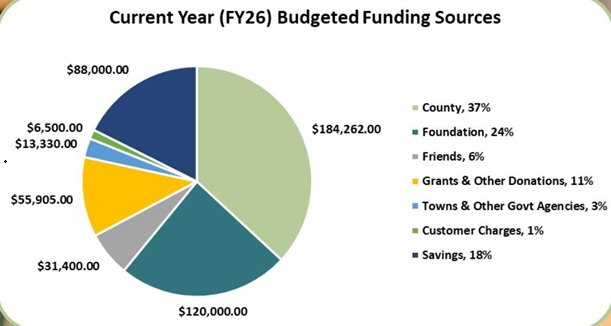
Photo – Library funding source graph – Courtesy Carbon County Library System
The Carbon County Library System took to social media to explain how its seven branches are funded.
Statewide property tax cuts have reduced the money available for counties to fund outside services, such as senior centers, museums, and libraries.
Last week, the Carbon County Library System uploaded a slideshow to social media titled Tax Dollars, Partners, and You. The presentation outlines where the library system receives its annual funding, how it’s operating with a 53 percent budget cut, and what the public can do to help.
Wyoming law requires each county to provide a library in the county seat. Seventeen of the state’s 23 counties support more than one library, with Sweetwater County operating nine and Carbon County seven. The Rawlins branch fulfills the county’s legal obligation, and the remaining six branches are additional services the county is not legally required to fund.
According to the Carbon County Library System’s social media post, running all seven branches is estimated to cost $500,000 this fiscal year. A chart included in the post shows the system receiving more than $600,000 from the county in 2015, followed by a sharp reduction the following year. Funding rose and fell over the next decade, with a $500,000 contribution in 2022 and a decline in 2023. County support remained relatively unchanged from 2023 to 2024, but in 2025, the county reduced its contribution to the library system by 53 percent.
In the 2025 through 2026 fiscal year, the county allocated roughly $184,000 to the library system, covering 37 percent of its total operational costs instead of the expected 55 percent.
The gap in county funding has traditionally been covered by grants, donations, contributions from towns, and support from the Carbon County Library Foundation and Friends groups. That additional income has allowed the library system to maintain seven branches across the county. The Sinclair Library, which had been the eighth branch, was closed in 2024 due to low usage.
Both, the Hanna and Medicine Bow libraries, were scheduled to close in November, but last‑minute grants and donations from PacifiCorp, the Wyoming Intertie Community Investment Program, and the Carbon County Library Foundation kept the northern county locations operating. At current funding levels, the Medicine Bow branch will remain open until next March, with Hanna funded through this May.
In addition, the Saratoga and Encampment‑Riverside Friends of the Library groups raised significant donations this fiscal year. Those funds support staffing and day‑to‑day operations at the two branches. The Carbon County Library Foundation has also increased its financial contribution, allowing the branches to offer more programs and activities in their respective communities.
Other budget gaps were covered by the library system’s savings accounts. However, Library Board members have cautioned that donations and savings are not a reliable funding source and should not be counted on to replace the county’s annual contribution. The system is expected to deplete its savings within the next fiscal year, and once the money runs out, hourly reductions and branch closures are likely to follow.
Most towns donate services and utilities, such as water, sewer, and snow removal, to their local branches. Other municipalities have offered to take ownership of their library buildings. Speaking to Bigfoot99 in February, Library Board Chairwoman Addie Myers said the Board appreciates the donated services, but they don’t affect the library system’s budget. Maintenance responsibilities fall to the county, which owns most of the facilities.
The bulk of the Carbon County Library System’s annual budget, 69 percent or more than $345,000, goes toward employee salaries. Staff are generally paid less than other government entities and are not given health insurance, and the system has only one full‑time employee.
The library system reported that over 43,500 people visited the county’s seven branches last year. While libraries offer residents access to books and movies, they also serve as a meeting space, provide access to computers and the internet, and host activities for the community. However, the loss of county funding has the library system warning that closures and further cuts to hours may be necessary.
Municipalities have reached out to the Board of Carbon County Commissioners asking for clarification regarding the proposed closures. The Board of Commissioners explained that they are not responsible for any library closures, and that the decisions rest entirely with the library system. While technically true, Library Board Chairwoman Addie Myers asked how the system is expected to operate on only 47 percent of its anticipated budget.
The Carbon County Library System was not the only entity to see its county funding reduced in the current fiscal year. The Carbon County Museum experienced an even greater loss, with 56 percent of its budget cut due to residential property tax relief programs. To address the lost revenue, the museum has begun charging out‑of‑county visitors an entrance fee and is now offering paid memberships to allow patrons to financially support the institution.
Speaking during the February 17th Board of Carbon County Commissioners meeting, Museum Board President Ken Klouda said museum staff are working to boost attendance, adding that Director Tom Mensik’s recent acquisition of a replica Columbian mammoth skull has been a strong draw.
The Carbon County Museum is also investigating the possibility of moving its entire collection into the Wyoming Frontier Prison. As two similar cultural institutions, the Board of Commissioners said it would make sense for them to be housed in the same location. In addition, the county would no longer have to maintain the current museum facility, further reducing costs.
County commissioners have asked the library system to consider a similar approach, such as relocating into senior centers and other community buildings. However, the need for specially trained librarians limits the library’s ability to collaborate with other entities.
Following the Museum Board President’s report, Commissioner John Johnson thanked the organization for taking steps to address the funding reduction rather than publicly criticizing county officials for making a difficult decision. His remarks were a direct reference to the library system’s social media messaging.
The Carbon County Library System is seeking donations to keep the county’s seven remaining branches open until a longer‑term solution, such as backfilling lost property tax revenue, can be found. Donations made to the library system itself or any of the Friends of the Library groups go toward staff and daily operational costs. Donations provided to the Carbon County Library Foundation allow the branches to update technology and increase community activities and programming.