
WEDNESDAY, June 3, 2026 |
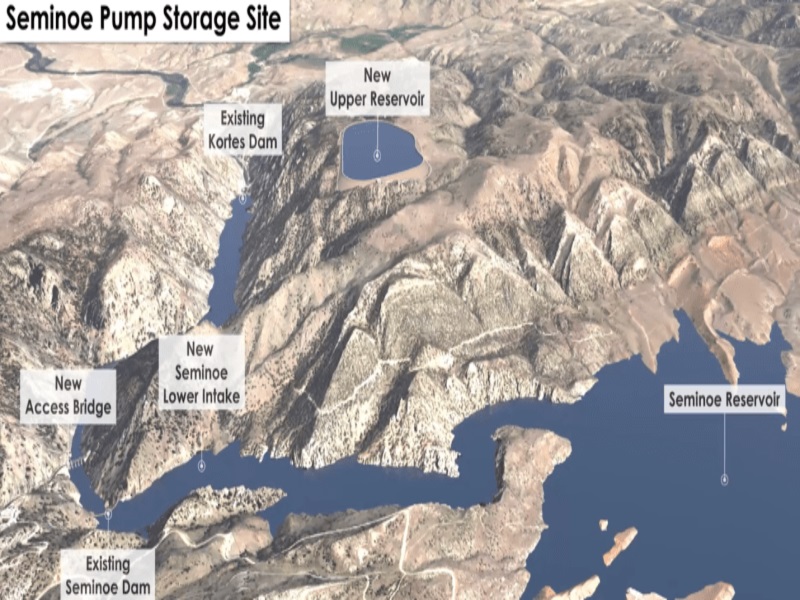
Photo – Seminoe Pumped Storage Project overview – Courtesy rPlus Hydro
Local officials also commented on the potential negative effects of the proposed Seminoe Pumped Storage Facility.
As reported by Bigfoot99 and Bandit102, the Wyoming Joint Travel, Recreation, Wildlife, and Cultural Resources Committee met on May 28th to hear testimony about the proposed Seminoe Pumped Storage Project. After hearing from state and federal agencies about their concerns over the impact the project may have on local fish and wildlife, the committee opened the floor to public comment.
During that period, Carbon County Commissioner John Espy testified that his concerns about the project stem from the revised National Environmental Policy Act, or NEPA, process. NEPA is the federal law that requires agencies to study and disclose the environmental effects of major federal actions before making decisions. However, the NEPA process works differently when the Federal Energy Regulatory Commission is involved, as it is in this case. FERC directs the environmental review instead of depending on land‑management agencies like the Bureau of Land Management, U.S. Fish and Wildlife Service, or the Bureau of Reclamation, all of which are involved in this project.
Commissioner Espy said the Board of Carbon County Commissioners relies on the standard NEPA process to identify any potential issues with a project.
Commissioner Espy recommended having the project proponent, rPlus Hydro, work with Wyoming Game and Fish and other resource‑management agencies before beginning the NEPA environmental review process.
The Seminoe Pumped Storage Facility must still be evaluated by the Wyoming Industrial Siting Council, which calculates and distributes impact assistance payments to offset the strain large industrial projects place on local infrastructure and government operations. Commissioner Espy said the Industrial Siting Council’s estimated allocation will not cover the cost of maintaining Seminoe Road during construction.
Commissioner Espy said the state has demonstrated that it can balance development with environmental protection but added that he was concerned about the lack of clear information on the Seminoe Pumped Storage Project.
After hearing all the testimony, the Joint Travel, Recreation, Wildlife, and Cultural Resources Committee voted to compile the questions raised by the public and committee members and send them to rPlus Hydro, the Federal Energy Regulatory Commission, Wyoming Senators Cynthia Lummis and John Barrasso, Congresswoman Harriet Hageman, and any current or future permitting agencies.
When the Board of Carbon County Commissioners met on Tuesday, Espy voiced his frustration with his experience testifying in Casper.
Despite his concerns, Commissioner Espy said the meeting provided an opportunity for the county to raise issues about rPlus Hydro’s perceived lack of environmental studies. Additionally, he said the meeting demonstrated that the Board of Carbon County Commissioners is involved in the regulatory process.
Commissioner Espy said he believes the Federal Energy Regulatory Commission is not meeting the Council on Environmental Quality’s requirements to evaluate a reasonable range of alternatives and hold meaningful public comment periods. He linked those concerns to the state of Wyoming’s refusal to participate as a cooperating agency.
Although local, state, and federal agencies have raised concerns about the project, Commissioner Espy said he believes the Federal Energy Regulatory Commission will sign off on the Seminoe Pumped Storage Facility. However, rPlus Hydro must still obtain an amendment to the Bureau of Land Management’s Rawlins Resource Management Plan to allow for year‑round construction, which will disturb the Ferris–Seminoe bighorn sheep herd, and to change the visual character of Seminoe Reservoir. Espy said the Board of Carbon County Commissioners will be involved in that process as well.